

Break, Break, Break (4 Musical Arrangements) Alfred, Lord Tennyson
Versions: V2-2:36 | V3-4:56 | V4-7:53
Break, break, break,
On thy cold gray stones, O Sea!
And I would that my tongue could utter
The thoughts that arise in me.
O, well for the fisherman’s boy,
That he shouts with his sister at play!
O, well for the sailor lad,
That he sings in his boat on the bay!
And the stately ships go on
To their haven under the hill;
But O for the touch of a vanish’d hand,
And the sound of a voice that is still!
Break, break, break
At the foot of thy crags, O Sea!
But the tender grace of a day that is dead
Will never come back to me.
This poem, titled “Break, Break, Break,” was written by Alfred, Lord Tennyson, one of the most renowned poets of the Victorian era in England. Published in 1842, the poem is a poignant expression of grief and loss, themes that were central to much of Tennyson’s work.
Tennyson (1809-1892) served as Poet Laureate of the United Kingdom during much of Queen Victoria’s reign. He is known for his lyrical poetry, which often dealt with themes of loss, the passage of time, and the conflict between faith and doubt in an increasingly scientific age.
“Break, Break, Break” is believed to have been inspired by the death of Tennyson’s close friend, Arthur Henry Hallam, in 1833. The poem’s structure and imagery powerfully convey the speaker’s sense of isolation and inability to express his profound sorrow.
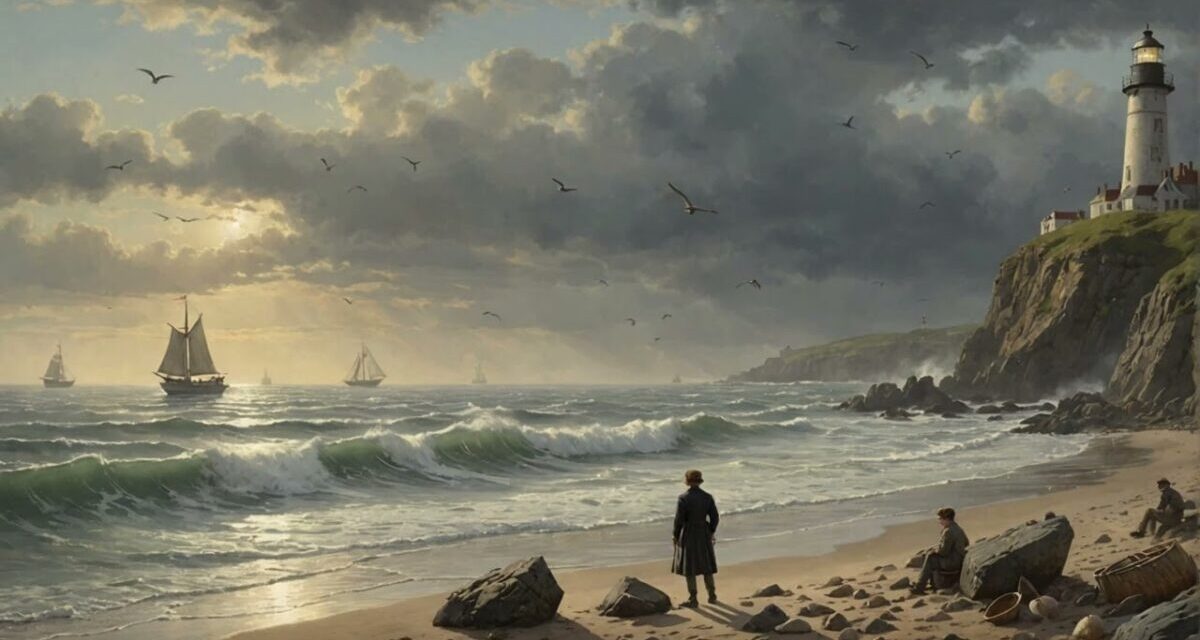
The poem is set by the sea, with the repetitive breaking of waves serving as a metaphor for the relentless nature of grief. The sea’s constant motion contrasts sharply with the speaker’s emotional paralysis. The imagery of the cold, gray stones further emphasizes the bleakness of the speaker’s emotional state.
Tennyson employs a range of poetic techniques in this work. The repetition of “Break, break, break” at the beginning and near the end of the poem creates a circular structure, mirroring the ceaseless motion of the waves and the cyclical nature of grief. The use of exclamation marks and the repeated “O” give the poem a plaintive, cry-like quality.
The poem also contrasts the speaker’s grief with the ongoing life around him – the playing children, the singing sailor, the ships continuing their journeys. This juxtaposition highlights the speaker’s sense of isolation and the way in which profound loss can make the ordinary world seem alien and distant.
#Tennyson #VictorianPoetry #Grief #Loss #SeaImagery #Melancholy #BreakBreakBreak #Longing #Memory #Time #musicalpoetry #FutureOfMusic #MusicTechnology #newrelease #musiclovers #musician #poetrylovers
As seen on YouTube.
Related in [Fitness]:
- Will Tennyson || Butthurt Or Not?
- Who Will Win In A Fight? Raven Vs Gwen#ben10#ben10alienforce#ben10edit#teentitans#raven#gwen#shorts
- I Tried The World’s Strictest Diet (According To Science)
- The Rock’s Cheat Meals For 30 Days
- Will Tennyson’s Anime Olympic Weightlifting Failure
Other posts:
- Looking At Next Gen Of Weight Loss: Tema ETFs CEO
- Yoga Dance With Our Yoginis | Har Har Shambu By Jeetu Sharma Abhilipsa Pandahar #shorts
- Covid: Fresh Protests In Europe Against New Restrictions @BBC News Live 🔴 BBC
- Dropa (2019) Movie Review Tamil | Dropa Tamil Trailer | Blisscinemas
- How I Lost Over 100lbs In 15 Weeks | My Final Weight Loss Results!!